PlanetSolar Brief

PlanetSolar Luxury Yacht Charter & Superyacht News

MS TÛRANOR PLANETSOLAR arrives in Cancún for the World Climate Change Conference

December 07, 2010

The World’s Largest Solar-Powered Boat docks in Cancún during the United Nations Framework Convention on Climate Change

MS TÛRANOR PLANETSOLAR in Miami

MS TÛRANOR PLANETSOLAR in Miami

Today, the world’s largest solar-powered boat, MS TÛRANOR PlanetSolar, has reached the shores of Cancun, Mexico. The first landing stage will be at the Marina La Amada, north of Cancún. On Wednesday, December 8, in the morning hours, the solar catamaran will sail from La Amada into the conference area of the UNFCCC (United Nations Framework Convention on Climate Change). With its presence at the conference, the boat will provide visible proof of efficient and forward-looking use of solar technology to improve the climate of the planet. Doris Leuthard, President of Switzerland and Environment Minister, is a supporter of the PlanetSolar project, which will gain further emphasis through the presence of Switzerland and the Swiss Confederation.

To date, MS TÛRANOR PlanetSolar’s circumnavigation of the globe has been quite successful. With its crew of six – Mikaela von Koskull (Finland), Jens Langwasser (Germany), Christian Ochsenbein (Switzerland) and Daniel Stahl (Germany), as well as captain Patrick Marchesseau (France) and project founder Raphaël Domjan (Switzerland) – the Swiss solar-powered ship has crossed the Atlantic just 61 days after its departure from Monaco, using solely the power of the sun.

MS TÛRANOR PLANETSOLAR on course to Cancún for the World Climate Change Conference

December 06, 2010

 The world’s largest solar boat, MS TÛRANOR PlanetSolar has set out from Miami and is on course for its next port of call: the World Climate Change Conference in Cancún.

MS TÛRANOR PLANETSOLAR in Miami setting course to Cancún for the World Climate Change Conference

MS TÛRANOR PLANETSOLAR in Miami setting course to Cancún for the World Climate Change Conference

At the world climate conference of the UNFCCC (United Nations Framework Convention on Climate Change) in Cancun , discussions are currently being held on the subject of climate change and the possible ways of providing sustainable environmental protection. On its roundthe- world voyage the solar catamaran MS TÛRANOR PlanetSolar, sailing under Swiss flag, is expected dock at the conference location Cancún on 6 December 2010. The boat’s presence will provide visible proof of an efficient and forward-looking use of solar technology to improve the climate.

To date the circumnavigation of the globe by MS TÛRANOR PlanetSolar has been very successful. With its crew of six – Mikaela von Koskull (Finland), Jens Langwasser (Germany), Christian Ochsenbein (Switzerland) and Daniel Stahl (Germany) as well as Captain Patrick Marchesseau (France) and project founder Raphaël Domjan (Switzerland), the Swiss solar ship crossed the Atlantic using only the power of the sun. It reached Miami and the American continent on 27 November, 61 days after its departure. The next port of call, Cancún, is an important stopover on the round-the-world voyage: 194 countries are currently focusing on world climate here.

Doris Leuthard, President of Switzerland and Environment Minister, is a supporter of the PlanetSolar project, which will gain further emphasis through the presence of Switzerland and the Swiss Confederation. All those involved hope that the presence of the solar boat at the United Nations world climate conference in Cancùn will give the negotiations and discussions of the participating countries a positive impulse.

The sleek catamaran, which impresses by its attractive appearance as well as its technology, was developed and built by a team surrounding Raphaël Domjan from western Switzerland and the German businessman Immo Ströher. By circumnavigating the globe the crew of six aims to prove that solar energy can be used to transport people and goods by sea in an environmentally friendly way.

“We want to show that we already have the technology, the knowledge and the means to change to sustainable energy sources. And we are all responsible for this change,” is how Raphaël Domjan, the initiator, explains the idea behind the project. Boat owner Immo Ströher emphasises: “We want to prove through our project that apart from static power generation, solar energy can also provide solar mobility. In this way, sustainable energy technology will be able to make a decisive contribution to climate protection in the transport sector.”

Technical details

The futuristic catamaran is of incredibly light yet very durable carbon-sandwich construction. It was the work of Craig Loomes from New Zealand, who is considered to be one of the world’s most innovative boat designers. The solar catamaran was built by the Kiel-based boatbuilding firm, Knierim Yachtbau.

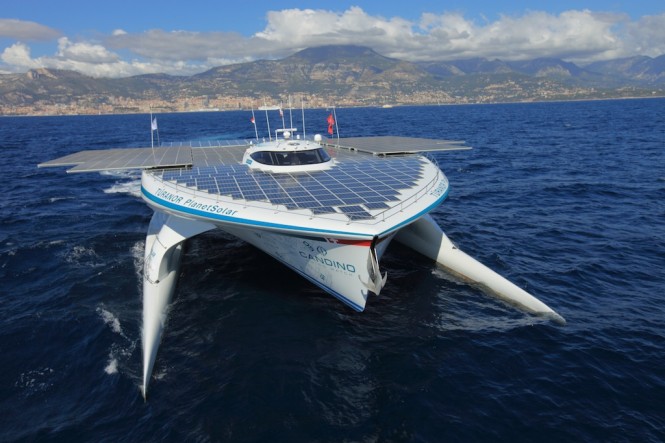
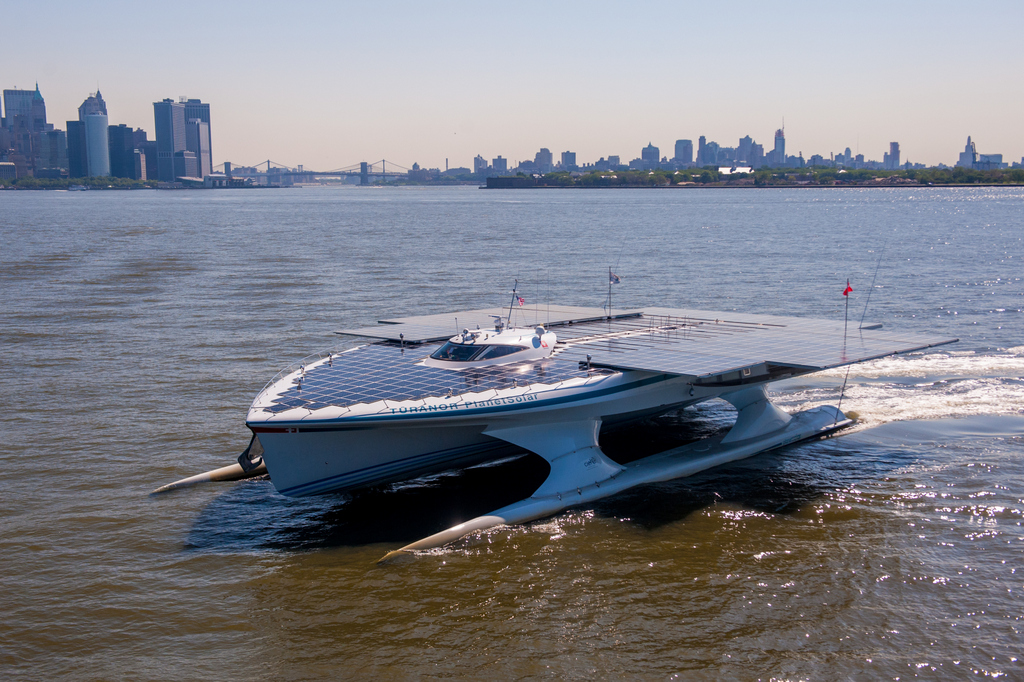
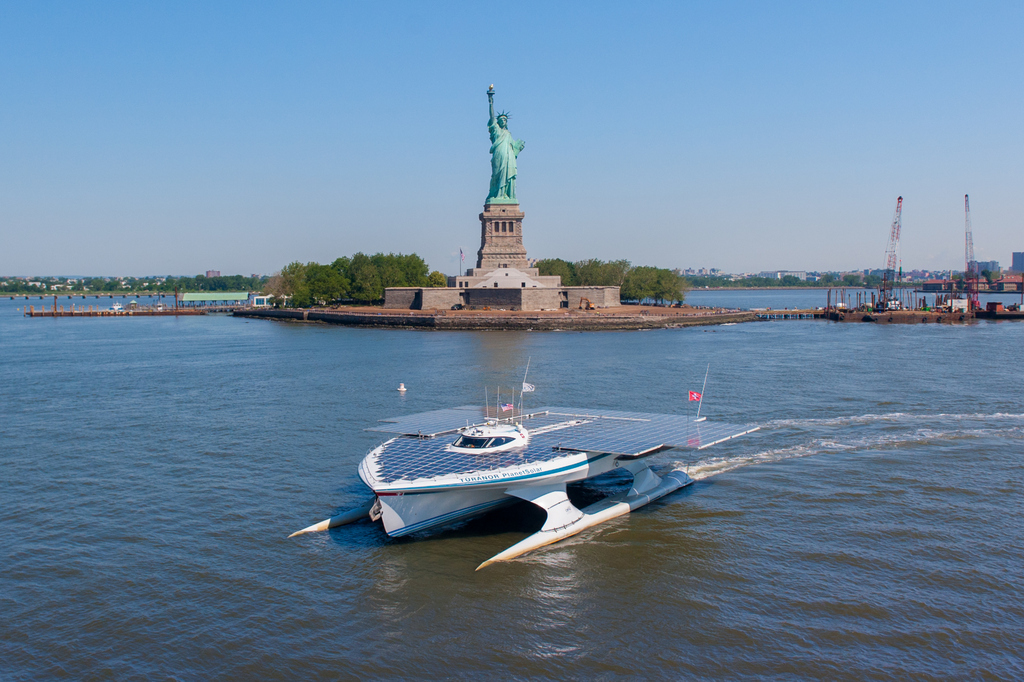
The most exciting feature of this double-hulled boat becomes apparent from an aerial perspective: the solar panels installed on deck were produced by Solon AG in Berlin using highly efficient photovoltaic cells from the US-based SunPower Corporation from San Jose in California. The 825 modules, equipped with 38,000 individual photovoltaic cells, cover a total surface area of 537 square metres. These capture the sun’s energy, which is then stored in blocks containing twelve batteries each (648 cells using the latest, maintenance-free lithium ion technology by GAIA from Nordhausen in Germany). Each of these six blocks weighs only about one-seventh as much as traditional lead batteries. Four electric motors – two per drive shaft – have a maximum output of 120 kW and an incredibly high energy efficiency of over 90%. They drive two contra-rotating carbon propellers. The diameter of each propeller is almost two metres, twice the usual size for a vessel of this size, which maximises the efficiency. The Swiss engineering firm drivetek AG (Ipsach/ Biel) was responsible for this specially developed highly efficient propulsion technology.

TÛRANOR PlanetSolar Catamaran reaches Miami, Florida.

November 28, 2010

With solar power across the Atlantic – Solar boat expedition reaches the American continent before continuing to Cancún for the World Climate Change Conference.

The TÛRANOR PlanetSolar has reached the American continent on its voyage around the world. This morning at 8.15 a.m. LT (1.15 p.m. UTC) the boat docked at the Miami Beach Marina (South Beach). 61 days, 0 hours and 34 minutes had passed between the boat’s departure from Monaco on 27 September 2010 and its arrival in Miami. The entire circumnavigation of the globe will take at least ten months.

TÛRANOR PlanetSolar Catamaran

TÛRANOR PlanetSolar Catamaran

Manned by a crew of six, the sleek catamaran TÛRANOR PlanetSolar developed and built for a German-Swiss team surrounding the Darmstadt eco-businessman Immo Ströher and the Swiss visionary Raphaël Domjan, is currently undertaking the first circumnavigation of the Earth using only solar power. The next port of call will be Cancún in Mexico. The arrival of the world’s largest solar-powered boat in Cancún is scheduled for 6 December to coincide with the World Climate Change Conference of the United Nations Framework Convention on Climate Change (UNFCCC).

“We have a goal in showing that we can change, that we have the technology, the knowledge, the means. It is possible for each of us to make a difference and it depends on both our individual and collective responsibility” says Raphael Domjan.

Imme Ströher, the boat owner, explains: “We want to show with our project that in addition to the stationary generation of power, solar energy can also provide solar mobility. In this way we can use sustainable energy technology to make a decisive contribution to climate protection in the sphere of transport,” explains Ströher.

PlanetSolar Catamaran TÛRANOR

PlanetSolar Catamaran TÛRANOR

To date the maritime transport sector has been considered as extremely wasteful with regard to energy.

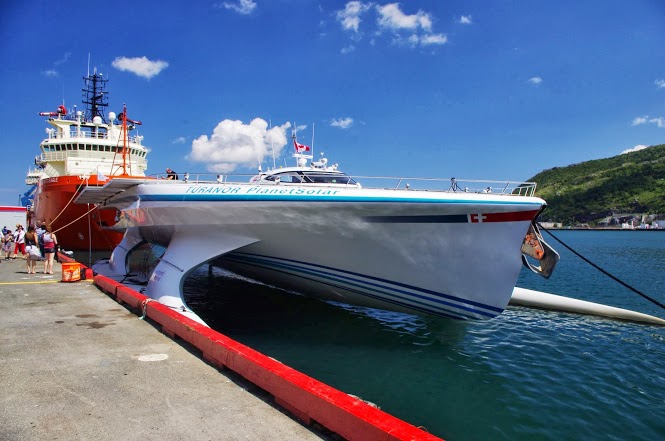
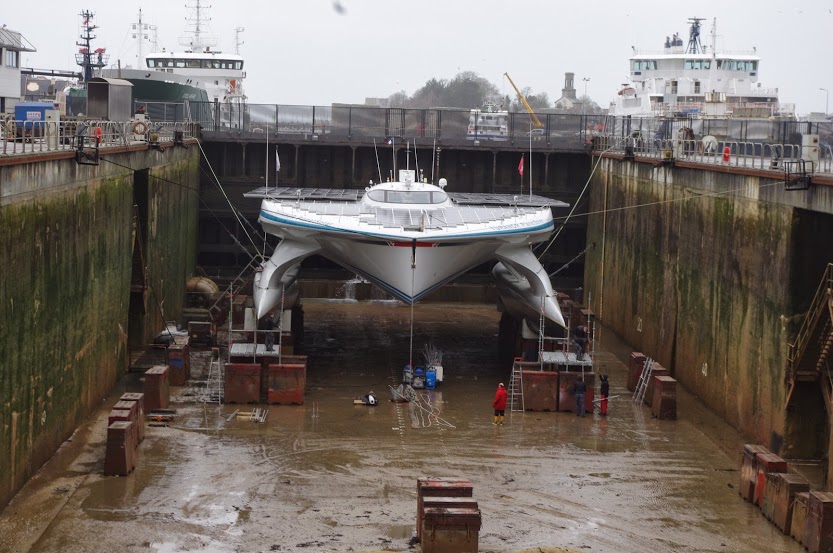
The catamaran TÛRANOR PlanetSolar is 31 metres long and 15 metres wide and is driven exclusively by solar energy. The name TÛRANOR is self-explanatory: it is derived from the Lord of the Rings trilogy by J.R.R. Tolkien and means “The Power of the Sun”. The experimental high-tech vessel has completed the first stage of its voyage across the “Big Pond” with stops in North Africa, the Canary Islands and the Caribbean to the complete satisfaction of its inventors.

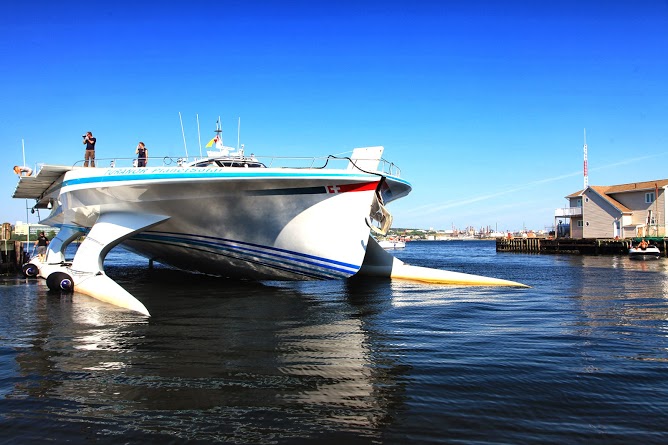
The futuristic electric motorboat is of incredibly light yet extremely durable carbon-sandwich construction. The boat was designed by the New Zealander Craig Loomes, one of the most innovative boat designers of the world today. Loomes designed the TÛRANOR PlanetSolar according to the so called “wave-piercing” principle, where the catamaran “cuts through” the waves. This uses less energy than is required for conventional concepts, where the boat “rides” the waves. The solar catamaran was built by the Kiel-based boatbuilders Knierim Yachtbau in close cooperation with HDW Howaldtswerke Deutsche Werft. A total of more than 20 tonnes of carbon fibre, 11.5 tonnes of foam core and 23 tonnes of resin and hardener were used.

The most exciting feature of this enormous double-hulled boat becomes apparent from an aerial perspective: solar panels by Solon AG from Berlin are installed on deck. These panels use highly efficient photovoltaic cells by the US supplier SunPower Corporation (San Jose, California). A total of 825 modules, equipped with 38,000 individual photovoltaic cells are mounted on a total surface area of 537 square metres. These capture solar energy, which is then stored in six dozen ultra-modern, maintenance-free lithium-ion technology batteries. The storage units weigh only one-seventh as much as traditional lead batteries.

Four electric motors from Nuremberg – two each per drive shaft – have a maximum output of 120 kW and an incredibly high energy efficiency of over 90 percent. They drive two contra-rotating carbon propellers from Voith Turbo Marine Composite Technology GmbH in Hohen Luckow near Rostock. It is interesting to note that the diameter of each propeller is almost two metres, twice the usual size for avessel of this size. This makes the propulsion more efficient.

The idea of circumnavigating the world using solar technology is the vision of the Swiss Raphaël Domjan, the founder of PlanetSolar. The PlanetSolar team consists of physicists, engineers, shipbuilders and enthusiastic supporters from all the corners of the globe who are committed to the concepts of environmental protection and the support for renewable energy. “We want to motivate engineers and scientists to develop innovative technologies. This is to show that visions are about to become reality,” explains Domjan. Eco-businessman Ströher points out: “We are on the way to showing that motorised shipping can also function without fuel.”

TÛRANOR PlanetSolar Catamaran’s Record Transatlantic Crossing

November 18, 2010

Fastest Transatlantic crossing in a solar boat – MS TÛRANOR PlanetSolar today registered record in St. Marteen – 26 days, 19 hours and 10 minutes from Las Palmas to the Caribbean Islands powered solely by the sun

TÛRANOR PlanetSolar Catamaran

TÛRANOR PlanetSolar Catamaran

On her expedition around the globe, MS TÛRANOR PlanetSolar, the world’s largest solar boat, is approaching the United States. Having left in Monaco on the 27th of September, TÛRANOR is planned to dock in Miami on Monday, November 29. Miami is the first major stopover on the world tour. In Miami, the boat is touching US American ground for the first time.

Today, on November 18, TÛRANOR PlanetSolar briefly stopped in St Martin to register the fasted Transatlantic crossing of a solar boat yet. For TÛRANOR, it took 26 days and 19 hours 10 minutes to cover the distance between Las Palmas and St Marteen (before: Sun21 crossing the Atlantic in 2007 in 29 days, 8 hours 30 minutes). PlanetSolar’s project founder Raphaël Domjan (38) and the TÛRANOR Crew – Captain Patrick Marchesseau, Mikaela von Koskull, Jens Langwasser, Christian Ochsenbein and Daniel Stahl have covered 2.690 miles / 4.982 kilometres from Las Palmas to St. Marteen.

A technological feat of German-Swiss cooperation, the catamaran, measuring close to 102 feet in length and 50 feet in width, is on a pioneering circumnavigation around the globe entirely without the use of traditional fuels. It is powered exclusively by solar energy. The project PlanetSolar, based on the shores of Lake Neuchâtel in Switzerland and initiated by the Swiss Raphaël Domjan, seeks to test the boundaries of solar technologies and inspire people across the world with its ambitious voyage, attempting the first circumnavigation of the seas exclusively with solar power. Sailing under Swiss flag, the TÛRANOR PlanetSolar is literally carrying the message of the potential of solar energy around the world. For this project, high-efficiency solar cells of the US manufacturer SunPower Corporation (San Jose, California) were used. Through extensive manual work, an exceptionally large marine solar generator with a total area of approx. 540 m2 was created.

Raphaël Domjan says: “It’s a success for the whole team of PlanetSolar and our partners who for many years have put their know-how into this wonderful project. We are very proud to demonstrate that ‘we have the technology to change’. The new technologies and renewable energy represent an opportunity for our society, and there is incredible potential and challenge for this industry and business in the near future.”

“This is a milestone in the progress of solar mobility,” says Immo Ströher, Eco-Businessman and owner of TÛRANOR PlanetSolar. “It is my vision to see solar power take its rightful place – not only on rooftops, but also on the roads, seas and in the skies of the future.”

TÛRANOR PlanetSolar will be leaving St. Marteen today at ca. 10.30 a.m. LT / 03:30 p.m. UTC and is proceeding on her way to Miami. After the stop in Miami, TÛRANOR will head for Cancun, where she will dock during the World Climate Conference, as a flagship carrying the message about the efficient application of renewable energies around the world (excepted arrival Dec 6).

TÛRANOR PlanetSolar Catamaran reaches the Canary Islands on 1st Solar boat expedition.

October 18, 2010

21 days after the start of the 1st solar boat expedition in Monaco, the MS TÛRANOR PlanetSolar today has reached the Canary Islands. After stormy weather in the Mediterranean Sea the boat has advanced quite fast, reaching Las Palmas today in the early afternoon. MS TÛRANOR PlanetSolar stay on Gran Canaria is planned till Friday. The stopover will also be used for maintenance.

Ms Turanor – PlanetSolar departing for solar boat expedition – Photo courtesy of PlanetSolar

Ms Turanor – PlanetSolar departing for solar boat expedition – Photo courtesy of PlanetSolar

After crossing the Strait of Gibraltar the solar catamaran has left the Mediterranean to continue its trip in the Atlantic Ocean. “We had to overcome some difficult currents, but our batteries were well loaded for the necessary propulsion and safe manoeuvres,” Captain Patrick Marchesseau explains. “We are very happy about the behaviour of the boat under difficult conditions.”

On the next leg of its journey MS TÛRANOR PlanetSolar catamaran will further cross the Atlantic. The current routing around the globe (subject to favourable weather and nautical conditions) foresees stopovers in several metropoles. In Miami, Cancun, San Francisco, Sydney, Singapore, Abu Dhabi and Monaco, the project PlanetSolar will inform the public about the importance of sustainability and renewable energies.

Ms Turanor – PlanetSolar departing for solar boat expedition – Photo courtesy of PlanetSolar

Ms Turanor – PlanetSolar departing for solar boat expedition – Photo courtesy of PlanetSolar

Based on favourable weather forecasts, the boat’s start has been rescheduled from spring 2011 to Autumn 2010.

With this 1st solar boat expedition around the world, the project founders and initiators draw the public attention to the concurrent possibilities of regenerative energies and its implications on environmental protection.

1st Solar boat expedition, ‘TÛRANOR PlanetSolar Catamaran’ reaches the Canary Islands - Credit PlanetSolar

1st Solar boat expedition, ‘TÛRANOR PlanetSolar Catamaran’ reaches the Canary Islands - Credit PlanetSolar

The six crew members are planning to circumnavigate the world by boat solely powered by solar energy. The boat will be navigating under Swiss flag, and the project enjoys the full support of the Swiss government.

The six crew members of Ms Turanor – PlanetSolar planning to circumnavigate the world by boat solely powered by solar energy - credit PlanetSolar

The six crew members of Ms Turanor – PlanetSolar planning to circumnavigate the world by boat solely powered by solar energy - credit PlanetSolar

The leading-edge solar catamaran (without flaps) boosts 31m in length, 16m in width, and approximately 540 square meters of solar panels as the solar generator. The specially developed energy storage should permit the boat to move for approximately 3 days and nights without sunlight.

The MS TÛRANOR PlanetSolar catamaran was designed by the extraordinary designer and constructor Craig Loomes of New Zealand and was built by high-performance yacht builder Knierim, based in Kiel (Germany).

TÛRANOR PlanetSolar Catamaran on her way to Atlantic Ocean

October 01, 2010

Three days after the start of the 1st solar boat expedition in Monaco, the MS TÛRANOR Planet Solar yacht proves well on her way to the Atlantic Ocean. The duration of the 1st tour around the world willlast 8 months minimum.

Ms Turanor PlanetSolar crew in Monaco - Photo courtesy of PlanetSolar

Several media have been reporting a length of 160 days, which is a preliminary status dating from beginning 2010. According to the press release of September 16, the 1st solar boat expedition around the globe will last 8 months minimum, depending on weather and climatologic conditions even considerably longer.

Ms Turanor - PlanetSolar departs Monaco 27 September 2010 - Photo courtesy of PlanetSolar

On the first leg of its journey yacht TÛRANOR PlanetSolar will cross the Atlantic. The current routing around the globe (subject to favourable weather and nautical conditions) foresees stopovers in several metropoles. In Miami, Cancun, San Francisco, Sydney, Singapore, Abu Dhabi and Monaco, the project PlanetSolar will inform the public about the importance of sustainability and renewable energies.

Ms Turanor PlanetSolar departs Monaco September 2010 - Photo courtesy of PlanetSolar

Based on favourable weather forecasts, the boat’s start has been rescheduled from spring 2011 to autumn 2010.
With this expedition, the iniatiors of this project want to focus the public awareness on the importance of renewable energies for environmental protection.

Ms Turanor PlanetSolar departs Monaco 27 September 2010 - courtesy of PlanetSolar

MS TÛRANOR PlanetSolar is a 31m multihull yacht fitted with a large array of photovoltaic solar panels. She was constructed in 14 months by Knierim Yacht Club, in Kiel, Germany to a design by the New Zealand company LOMOcean Design.   TÛRANOR PlanetSolar is the biggest solar boat ever built with very impressive dimensions, not to mention she is clean and very silent. The goal is to navigate around the world at an average speed of 7.5 knots – no mean feat for a solar-powered craft.

Ms Turanor PlanetSolar departs Monaco 27 September 2010 - Image courtesy of PlanetSolar

The multihull will be a home to four sailors during the round-the-world attempt, and can accommodate up to forty people during the promotional trips planned at each port of call.

MS TÛRANOR PlanetSolar catamaran runs solely on energy found in light. The additional removable parts allow her to expose a total of 537 m2 of photovoltaic surface to the sun. This jaw-dropping data make PlanetSolar the biggest solar run ship in the world.

Ms Turanor PlanetSolar departs Monaco 27 September 2010 - Photo courtesy of PlanetSolar

Technical information about MS TÛRANOR PlanetSolar

Length: 31m
Width: 15m
Length with flaps: 35m
Width with flaps: 23m
Height: 6.1m
Weight: 95 t
Surface of solar modules: 537 m2
PV panel efficiency: 18.8%
PV installed power: 93.5 kW (127.0 HP)
Average engine consumption: 20 kW (26.8 HP)
Average speed: 7.5 knots (14km/h)
Maximum speed: 14 knots (25 km/h)
Crew: 6
People that can go onboard: 40
Autonomy: Never ending solar navigation

Princess Cruises honoured by Port of San Francisco for environmental efforts.

May 25, 2010

Three Princess Cruises ships Sapphire Princess, Sea Princess and Star Princess  have just been named as gold-level winners of the Port of San Francisco 2009 Cruise Ship Environmental Award. The awards honor the ships’ “outstanding record in safeguarding the environment and protecting the air and water quality of San Francisco Bay during their port calls.” This is the fifth year Princess ships have earned this prestigious distinction.

Sapphire Princess

Sea Princess

Star Princess


The annual award recognizes the vessel for demonstrating ”the strong environmental commitment of Princess Cruises in the areas of air emission reduction, waste water treatment, and recycling and disposal programs for solid waste.” The honors are determined by San Francisco’s Cruise Terminal Environmental Advisory Committee (CTEAC), which operates a program to recognize cruise lines that are committed to environmentally responsible operations, include the deployment of ships using reduced emission system technology or cleaner-burning fuel.

The San Francisco awards follow on the heels of other environmental honors earned from ports where Princess ships call, including the Venice Blue Flag, recognizing the line’s commitment to reducing polluting emissions by burning cleaner fuels, plus the Port of Los Angeles Vessel Speed Reduction Recognition Flag for actions to reduce air emissions.

The Venice Blue Flag is awarded for the line’s efforts to safeguard the city of Venice, Italy, by burning low sulfur fuel in port to reduce air emissions. The flag recognizes ship companies who make a commitment to preserve this unique city and its historic monuments. This was the second year Princess has been honored with this flag. Four Princess ships — Royal Princess, Ruby Princess, Crown Princess and Grand Princess called in Venice in 2009.

The Vessel Speed Reduction Flag recognizes Princess ships based at the Port of Los Angeles for following reduced speeds while entering and leaving the port as part of an effort to reduce air emissions. Princess was the only cruise line to earn this award, with all three home-ported vessels — Sapphire Princess, Golden Princess and Coral Princess — commended for 100 percent compliance in following the reduced speeds.

“We are gratified that our environmental efforts are being recognized in many different ways in places around the world,” said Jan Swartz, Princess Cruises executive vice president. “We make our living taking people to beautiful destinations. We’re committed to doing our part to make sure they stay that way.”

Princess Cruises is committed to environmental practices which set a high standard for excellence and responsibility, and which help preserve the marine environment in which its ships operate. The company’s environmental goals and policies go beyond what is required by law and include a zero solid waste discharge policy, state-of-the-art environmental technology and waste management equipment, programs to minimize waste generated, and recycling where possible. The company also pioneered the use of shore power programs in the cruise industry to reduce air emissions.

It is good to see members of the cruise industry committed to responsible environmental practices as well as many Superyachts who are also employing state-of-the-art environmental technology. Notable Superyachts with eco friendly designs are  SOLILOQUY  and  PLANETSOLAR .  Perhaps we will see further trends in Superyacht and cruiseship building and design leading to a greener approach.

Imtech technology partners PlanetSolar

May 07, 2010

Imtech N.V. (technical services provider in Europe) announces that it is acting as technology partner of PlanetSolar, the largest ship powered by solar energy in the world. The ship is being officially exhibited today on the occasion of the 821st birthday of Hamburg’s harbour. In 2011, PlanetSolar will set sail on a world cruise of approximately 50,000 km, with the aim of promoting solar energy and the use of environmentally-conscious alternative fuel for sailing.

René van der Bruggen, CEO of Imtech: ‘Society is becoming increasingly sustainable and technology is playing a leading role in this process. The trend towards ‘green’ technical infrastructure, which started in the energy, buildings, and data centres markets, is now also obvious present in the maritime market. Being a technical services provider with the ability to integrate high-tech energy technology in our total portfolio (electrical solutions, ICT and mechanical solutions), our ‘green’ services package matches this social trend perfectly. Also we possess a large number of sustainable technical competencies. The order for PlanetSolar and several other maritime initiatives have resulted in Imtech becoming a ‘green frontrunner’ in the global maritime market.’

High-tech catamaran covered by solar panels.

PlanetSolar is a high-tech 85-ton, 31-metre long and 15-metre wide catamaran, which is covered by 537 m2 of solar panels. The futuristic-looking ship is powered by two 10 kW electric motors. On board it has the world’s largest lithium-ion battery, with a power storage capacity of 2910 Ah and a weight of 11 tons. In total, PlanetSolar can travel 1,000 km without sunlight. PlanetSolar has a top speed of 14 knots (25 km/h) and can house around 40 guests. It produces zero environmental pollution and the ship moves noiselessly. The Knierim Shipyard together with HDW constructed the ship in Kiel, Germany.

Energy promotion cruise around the world in 140 days

PlanetSolar is an initiative of Swiss national Raphaël Domjan, president and skipper of the ship. Jean Verne, the great-grandson of Jules Verne is one of the project’s ‘godfathers’. This is the first ship to undertake a cruise around the world powered entirely by solar energy. The 50,000 km journey is expected to take 140 days at an average speed of 8 knots (15 km/h). The planned route is via the Atlantic Ocean, through the Panama Canal, across the Pacific and Indian Oceans, and home via the Suez Canal and the Mediterranean Sea. ‘Energy Consciousness Stops’ will be made amongst others in New York, San Francisco, Darwin, Hong Kong, Singapore, Abu Dhabi and Marseilles.

Imtech: technology partner for ‘green’ technology

Imtech is acting as technology partner on PlanetSolar and is responsible for the project management, engineering, implementation and commissioning of the high-tech energy distribution system, the technology that provides for charging the lithium-ion battery, the alarm & monitoring system and the cable system. Imtech is a frontrunner in ‘green’ infrastructure for ships. For instance, Imtech has provided a large part of the ‘green’ technical infrastructure on board the ‘Rainbow Warrior III’, the new flagship of Greenpeace. In the USA, Imtech is involved in an ecological sightseeing boat powered by a combination of solar energy and sustainable electrical propulsion. Together with Feadship (designer and builder of luxury yachts) and MTU (builder of ships’ engines), Imtech is researching the possibilities of constructing ‘green’ luxury (mega) yachts. Recently Imtech has also developed a ‘smart battery concept’ for the long-term distribution of energy on board ships.

Planetsolar – the World’s Largest Solar Powered Yacht Launched

April 06, 2010

PLANETSOLAR's launch

Catamaran PLANETSOLAR which is the world’s largest solar powered yacht designed to circumnavigate the globe was launched to celebration on the 31st of March 2010.  The PlanetSolar catamaran was designed by Raphael Domjan and built by Knierim Yacht Club in Kiel in northern Germany.

Super yacht PLANETSOLAR – the largest solar-powered catamaran in the world touched the water for the first time on the 31st of March. An enormous and very imposing crane tower over 110 metres, removed the massive 60-ton PlanetSolar from her hangar and placed her delicately into the Baltic Sea where she will remain for a test period of several months before she is shipped to the Mediterranean. The manoeuvre took over an hour and guests enjoyed the spectacle of the “flight” of PlanetSolar in the skies over Kiel in Germany.

The yacht PLANETSOLAR expects to undergo tests and use the propellers for the first time in April. From the 5 to 10 May 2010 the first voyages and celebrations will be held in the port of Hamburg.

 We will keep you updated on developments regarding PLANETSOLARContact the CharterWorld team for further information or to enquire about chartering a yacht for your own private world tour!

Planetsolar – the World’s Largest Solar Powered Yacht will circumnavigate the globe in 2011.

March 03, 2010

Planetsolar 30m solar powered catamaran


A selection of international scientists, engineers and boat builders from Germany and Switzerland have developed the world’s largest solar powered yacht designed to circumnavigate the world. The PlanetSolar catamaran, conceptualised by Swiss designer Raphael Domjan and built by Knierim Yacht Club in Kiel in northern Germany, was unveiled on February 25, 2010 at the HDW Shipyard in Kiel, Germany.  

PlanetSolar is expected to begin testing in late March and will prepare to set sail on its maiden voyage to circumnavigate the globe in April 2011. With a top speed of 15 knots — she is expected to be the fastest solar boat to cross the Atlantic Ocean and the first to cross the Pacific. The planned route around the world will start from Europe. It is expected to reach an average speed of 8 knots and cover approximately 40,000km in around 4 months.  

A total of 500 sq metres (about 5,300 square feet) of solar panelling made up with some 38,000 SunPower cells will help to power the yacht.  Each of the new generation cells used has “an efficiency of at least 22 percent”, delivering 103.4kW (138.6HP) making them the highest-efficiency solar cells commercially available. If the day is overcast, batteries below deck store enough energy for several days without direct sunlight. Her design also enables her to easily carve through the water increasing her maximum speeds.   

Catamaran PlanetSolar measures 30m by 15m, is estimated to cost around $24 million, weighs in at 60 tonne and features a sleek eco friendly design likely to influence future trends in yachting. The yacht was constructed by the company PlanetSolar, who have declared “we want to show that we can change, that solutions exist and that it isn’t too late. Future generations are looking to us; our choices will mark the future of humanity.”  

The company PlanetSolar is committed to sustainable development and is particularly motivated by the necessity to develop alternatives to fossil fuels which are in limited supply and causing measurable negative environmental impact. Perhaps we will see further trends in Superyacht building and design leading to a greener approach. Other notable Eco-friendly designs beginning to surface include such designs as Alastair Callender’s Soliloquy.  

The first solar powered boat to cross the Atlantic was the Swiss, 15 meters Solar21 catamaran.  It made the journey between the Canary Islands and Martinique in 29 days at a top speed of 9 knots reaching Miami on March 29, 2007.  

Two crew will man the catamaran PlanetSolar during its world tour and the craft will be available for public displays – able to host up to 50 guests for an educational opportunity at each of its planned stops. Stop over ports under consideration (subject to change) include Monaco, Marseille, New York, Acapulco, San Francisco, Cairns and Darwin, Shanghai, Hong Kong, Singapore, Abu Dhabi, and Dubai.