Eco Friendly Yacht Brief

eco friendly yacht Luxury Yacht Charter & Superyacht News

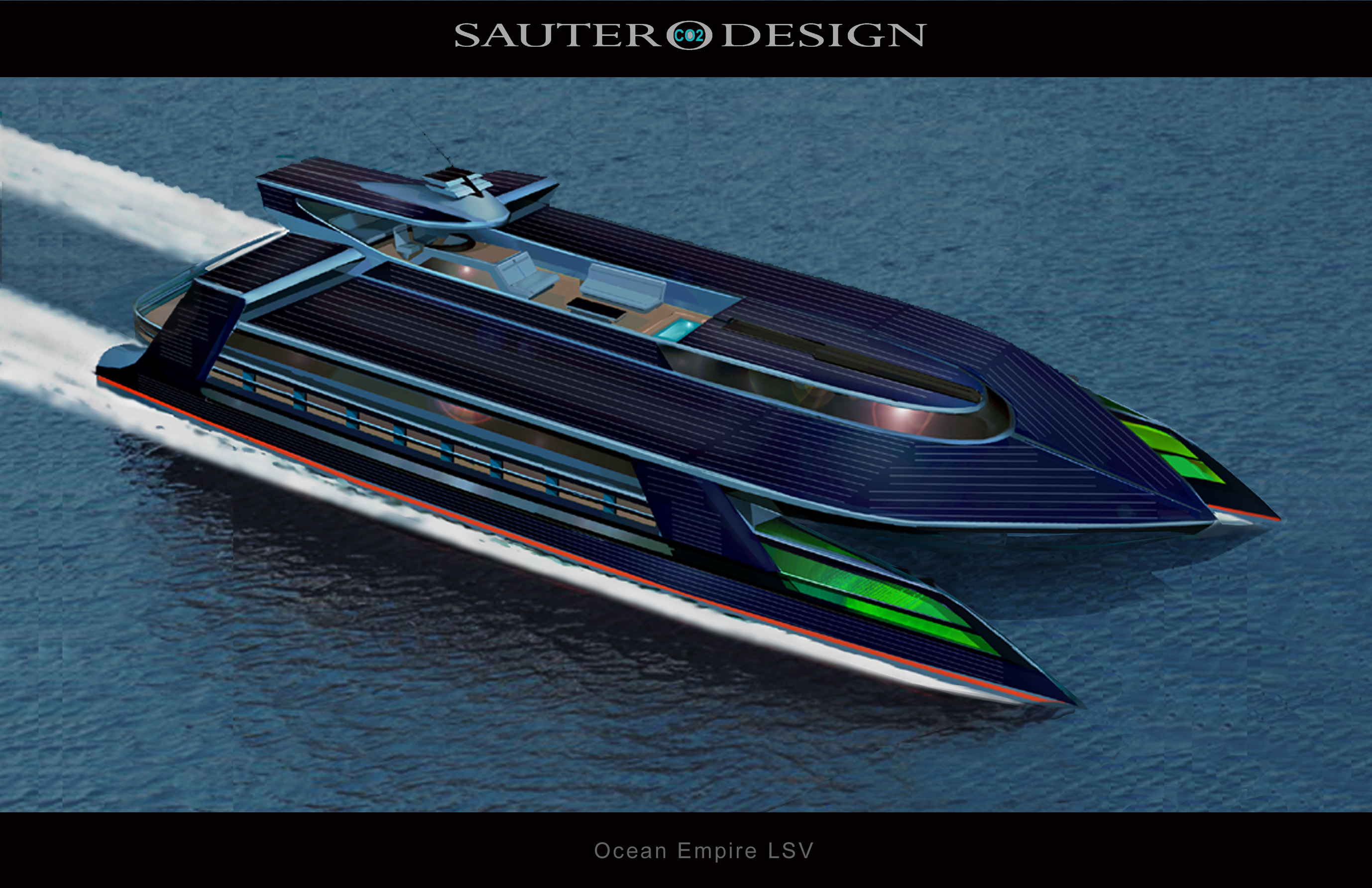
Ocean Empire LSV by Sauter Carbon Offset Design – The World’s First Self Sufficient Zero Carbon Superyacht.

January 05, 2011

The Ocean Empire LSV (life support vessel) is a 44m Solar Hybrid Superyacht with 2 Hydroponic farms and fishing facilities to harvest the sea. Her solar powered propulsion systems and all the Hotel amenities of a luxury global voyager are supplied by harnessing 3 major sources of sustainable of energy.

Ocean Empire LSV  by Sauter Carbon Offset Design - The World’s First Self Sufficient Zero Carbon Superyacht

Ocean Empire LSV by Sauter Carbon Offset Design - The World’s First Self Sufficient Zero Carbon Superyacht

The first and foremost source of energy is from the Sun which powers Solar Cells (covering the entire surface of the vessel) while at the same time illuminating 2 Hydroponic farms.

The second source is energy from the Wind which powers an auxiliary automated SkySail that drives the Ocean Empire to 18+knots while charging her GM ESS2 batteries through power sailing KER.

The third source is energy from Waves captured through Motion Damping Regeneration (MDR).  A new form of ATMD (Adjustable Tuned Mass Damper) developed in collaboration with Maurer Sohnes Gmbh

Ocean Empire LSV by Sauter Carbon Offset Design - The World’s First Self Sufficient Zero Carbon Superyacht

Ocean Empire LSV by Sauter Carbon Offset Design - The World’s First Self Sufficient Zero Carbon Superyacht

The MDR system is basically an ATMD utilized in skyscrapers such as Taipei 101 to reduce their swaying motion. In this application 16 tons of batteries are the Mass while linear generators produce up to 50 kws of electricity as they dampen the motion of the vessel.

Richard Sauter head of design commented “The Ocean Empire life support Superyacht liberates the Superyacht community from its strict dependence on unsustainable resources by harnessing the renewable collective power ever present in the Earths Biosphere”.

Ocean Empire LSV  by Sauter Carbon Offset Design

Ocean Empire LSV by Sauter Carbon Offset Design

The Ocean Empire LSV is a state of the art Superyacht catamaran. As such her Green Tech innovations are able to optimize what is easily the most dynamic form of ocean going platform. Her Daimler Turbo Compound BueTec engine is the most advanced EPA Diesel ever built.  Her Sunpower Solar Cells are the most efficient to date as are her Voith Surface Drives.

Employing existing OEM products and costing little more than her conventional Superyacht counterparts. Ocean Empire’s Solar Hybrid design offers every available Superyacht luxury within her full range of operation which extends from a 50% reduction in fuel consumption and CO2 emissions to Ultra Green Carbon Neutral and Zero Carbon cruising.

As a Charter, a Plugged in Ocean Empire LSV is capable of feeding 360+Mwh’s of electricity to the grid. Enough energy to make up to 12,000 nautical miles of Chartered Carbon Neutral voyages every year

Existing OEM technology present in the Ocean Empire LSV;

•             Daimler Turbo Compound DD16 Electric Power Generation
•             SkySail Automated Traction Kite
•             SunPower Solar Cells
•             GM Allison Electronic Controller (KER) (Kinetic energy regeneration)
•             Maurer Sohnes Gmbh  Motion Damping Regeneration. (MDR)
•             Voith Turbo Advanced Propulsion Surface Drives
•             Carbon Composite Wave Piercing Hi-efficiency displacement hulls
•             Advanced Aerodynamic Radar Canopy with PV Wing Spoilers
•             Energy Efficient Equipment, AC & Refrigeration with Waste Heat Recovery
•             Plug-in Computerized Energy Management, Maintenance & Guidance.
•             GM Allison ESS2 Battery Storage UPS rated at 2,000Kwh.

Ocean Empire LSV Specifications:
Length 44m
Beam    15.5m
Draft      0.8m
Guests 10
Crew     8
Weight                 <85tons
2 Hydroponic  farms        30sq.m
SkySail 200kw
SunPower solar cells       70kw
Maure Sohnes MDR       50kw
Daimler DD16 Diesel Electric power generation  350kw
Siemens AC induction motors    300kw
Voith propulsion surface drives 1.5m
Fuel: Diesel/GM ESS2  batteries                20t/2,000kwh
Maximum speed              18+knts
Cruising speed  12+knts
Hybrid power sailing cruising range at 18knts       3,500+nm
Zero Carbon power sailing range at 14 knots average      Unlimited
Carbon Neutral power sailing range         <12,000+nm
Zero carbon motoring range at 10knts average   Unlimited

The Marvin 50 eco-sustainable motor cruising catamaran design

August 03, 2010

“Marvin the Martian” is a 50′ eco-sustainable fiberglass cruising catamaran. The need of becoming “green” has become a pressing matter in boating during recent years. This catamaran design project’s goal was to create a boat capable of being autonomous and self-sufficient from an energy standpoint.

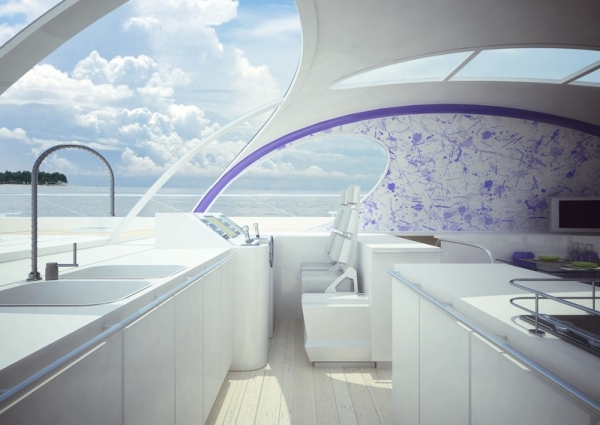
Marvin 50 - interior

Marvin 50 - interior

This type of catamaran is placed right between sailing and motor boating. Since sailing has always been the most eco-friendly way to cruise the seas, this project suggests the creation of a third category of boating that bears characteristics found in both sailing and motorboats. This necessity – an eco-sustainable motorboat – derives from the market’s needs; in fact, only a 10% of the international boating market corresponds to acquisitions of sailing boats. The low percentage can be explained by numerous factors, not least of which is the need for a very specific instruction in order to sail. The remaining 90% prefers to experience sea life in a more indirect way so, therefore, the idea of offering a cruise yacht that does not require particular abilities or instruction, while at the same time remaining eco-sustainable – providing low gas consumption and a silent navigation – could become an intriguing alternative.

Marvin 50 - the eco-sustainable catamaran

Marvin 50 - the eco-sustainable catamaran

In order to achieve these goals, an abundance of design decisions had to be taken. First and foremost, the choice of two hulls – a catamaran. This decision allowed for less resistance in the water and therefore less propulsion energy. The boat is designed to be constructed using the most advanced technologies in the field today; vacuum infusion epoxy resins and Kevlar laminates where employed to achieve a lightweight yet inexpensive hull. The same lightweight approach was employed for the superstructure by using modern materials that conform to EU regulations. The multihull also allows for more space above deck; this provides an area of 35 sq m (380 sq f) of photovoltaic panels, supplying the vessel with enough energy to become self-sufficient.

Marvin 50 motor catamaran

Marvin 50 motor catamaran

Propulsion of the Marvin 50′ eco-sustainable motor cruising catamaran relies on an electric/diesel engine, presenting various options to the user; from a completely “electrical” propulsion, to a completely diesel one. The first option offers a 30Nm of autonomy at a 5 kn cruising speed, while a combination of electric and diesel propulsion can achieve a 487Nm autonomy at 9 kn, by consuming only 400 liters of fuel. Services onboard are comprised of A+ Energy Efficiency class equipment and LED illumination. The openings found on deck are strategically placed in order to provide sufficient daylight and flow of air so as to eliminate the need of A/C, which would require vast amounts of energy.

Marvin 50 catamaran - foredeck

Marvin 50 catamaran - foredeck

These technological innovations don’t come bundled in a blunt and unimaginative shell, though. The yacht’s captivating lines and broad spaces, both externally and internally, create an aggressive profile, without giving up on space comfort. The catamaran can accommodate up to 8 guests in its two hulls, whilst on deck level a kitchen – with an unobstructed view of the bow, a dinette and a living room provide the relaxing space for all day-to-day activities, illuminated by large apertures in the boat’s shell.

Marvin catamaran - aft view

Marvin catamaran - aft view

Short Specification for the Marvin 50 Catamaran:

Type: Cruising catamaran
Size: 50′ (15 meters)
Project: 2010
Progress: Concept
Designer: Maria Malindretou – Vika
 

Marvin 50 - the eco-sustainable catamaran - aft deck

Marvin 50 - the eco-sustainable catamaran - aft deck

The Marvin Catamaran has been featured on:

- Yanko Design: Yacht So Green it’s Alien
- Inhabitat: Marvin the Martian: An Eco-Friendly Solar-Powered Pleasure Boat
- Engadget: Meet Marvin, the ginormous solar-assisted catamaran
- Ecofriend: Marvin the Martian pleasure boat cruises on solar energy
- Greenlaunches: Marvin the Martian cruising catamaran powered by solar energy
- SuperYachtDesign: Marvin the Martian
- Oceanshaker: The Eco-Sustainable Catamaran Marvin The Martian
- FirstLuxe: Marvin, le cata’ à la fibre écolo

Mal-Vi S.A. is a construction company with 21 years of experience in architectural design, building development, with partecipations in numerous international architecture competitions. It is based in Thessaloniki, Greece.

Marvin 50 - saloon

Marvin 50 - saloon

Planetsolar – the World’s Largest Solar Powered Yacht will circumnavigate the globe in 2011.

March 03, 2010

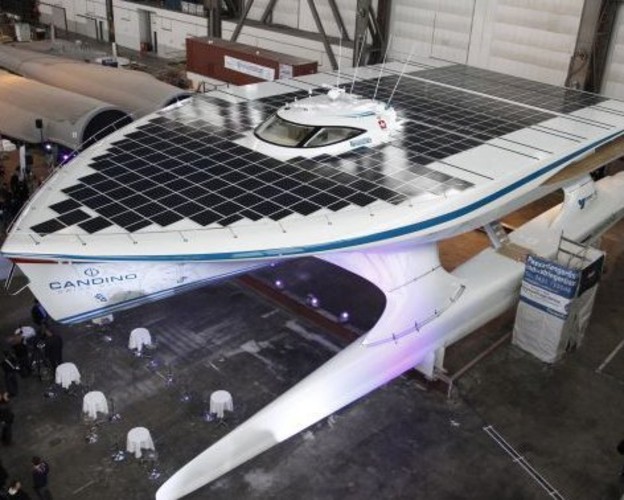
Planetsolar 30m solar powered catamaran


A selection of international scientists, engineers and boat builders from Germany and Switzerland have developed the world’s largest solar powered yacht designed to circumnavigate the world. The PlanetSolar catamaran, conceptualised by Swiss designer Raphael Domjan and built by Knierim Yacht Club in Kiel in northern Germany, was unveiled on February 25, 2010 at the HDW Shipyard in Kiel, Germany.  

PlanetSolar is expected to begin testing in late March and will prepare to set sail on its maiden voyage to circumnavigate the globe in April 2011. With a top speed of 15 knots — she is expected to be the fastest solar boat to cross the Atlantic Ocean and the first to cross the Pacific. The planned route around the world will start from Europe. It is expected to reach an average speed of 8 knots and cover approximately 40,000km in around 4 months.  

A total of 500 sq metres (about 5,300 square feet) of solar panelling made up with some 38,000 SunPower cells will help to power the yacht.  Each of the new generation cells used has “an efficiency of at least 22 percent”, delivering 103.4kW (138.6HP) making them the highest-efficiency solar cells commercially available. If the day is overcast, batteries below deck store enough energy for several days without direct sunlight. Her design also enables her to easily carve through the water increasing her maximum speeds.   

Catamaran PlanetSolar measures 30m by 15m, is estimated to cost around $24 million, weighs in at 60 tonne and features a sleek eco friendly design likely to influence future trends in yachting. The yacht was constructed by the company PlanetSolar, who have declared “we want to show that we can change, that solutions exist and that it isn’t too late. Future generations are looking to us; our choices will mark the future of humanity.”  

The company PlanetSolar is committed to sustainable development and is particularly motivated by the necessity to develop alternatives to fossil fuels which are in limited supply and causing measurable negative environmental impact. Perhaps we will see further trends in Superyacht building and design leading to a greener approach. Other notable Eco-friendly designs beginning to surface include such designs as Alastair Callender’s Soliloquy.  

The first solar powered boat to cross the Atlantic was the Swiss, 15 meters Solar21 catamaran.  It made the journey between the Canary Islands and Martinique in 29 days at a top speed of 9 knots reaching Miami on March 29, 2007.  

Two crew will man the catamaran PlanetSolar during its world tour and the craft will be available for public displays – able to host up to 50 guests for an educational opportunity at each of its planned stops. Stop over ports under consideration (subject to change) include Monaco, Marseille, New York, Acapulco, San Francisco, Cairns and Darwin, Shanghai, Hong Kong, Singapore, Abu Dhabi, and Dubai.